
THE UKRAINIAN MUSEUM’S 50TH ANNIVERSARY SEASON OPENS WITH TWO SPECIAL EXHIBITIONS
Our Milestone year launches with Zhyve Polotno / A Living Canvas and The Ground Shifts Beneath Our Feet — the first North American museum exhibition of the work of Zhanna Kadyrova.
NEW YORK, NY — The Ukrainian Museum opens its 50th anniversary year with Zhyve Polotno / A Living Canvas and The Ground Shifts Beneath Our Feet — the first exhibitions in a rich series of programs that will unfold across 2026–2027.
In this moment, when Ukraine and its vibrant culture face an existential threat, the Museum’s mission is more urgent than ever: to preserve and advance Ukrainian art and heritage, and to serve as a vital instrument of resilience that attracts a broad audience of local residents, students, scholars, artists, tourists, and New Yorkers seeking to engage with diverse histories and contemporary issues.
Zhanna Kadyrova — The Ground Shifts Beneath Our Feet
Second Floor Gallery; Glass Box; and Museum Lobby • Opens June 20, 2026
(Press Preview: June 18, 12 – 6 pm)
In The Ground Shifts Beneath Our Feet, Kadyrova explores the experiences of displacement, resistance, and regeneration through transformations of Ukraine’s physical landscape. Across five bodies of work made in the years following Russia’s full-scale invasion, Kadyrova considers how Ukraine’s land, the earth itself, responds to the threat of erasure with renewal.
Through sculpture, embroidery, photography, and film, Kadyrova lays bare the ways in which ‘Earth’ becomes a site of violence, memory, and resilience. From the destruction of the Kakhovka Dam and decimation of its reservoir ecosystem to the mining of agricultural land, the five works that comprise the exhibition attest to how ordinary life survives despite extraordinary pressure.
Palianytsia, Russian Rocket, and Embroideries (2022–) are three ongoing works created in the aftermath of the full-scale invasion, which Kadyrova will continue to enlarge as long as the war continues.

Palianytsia is her iconic series named for the Ukrainian bread that became a marker of identity under occupation; Russian Rocket the series of short videos superimposing Russian rockets onto landscapes visited by the artist; and Embroideries consists of woven portraits that conflate domestic tranquility with the persistent presence of air alarms.
Kadyrova’s large-scale video installation The Forest (2025) examines the consequences of the destruction of the Kakhovka Dam by Russia in June 2023, and the surreal new growth rising from the dried bed of the destroyed reservoir. Realized with The Dovzhenko Centre film archive in Kyiv, the City of Zaporizhzhia and the Khortytsia Museum, The Forest is part of a collaborative effort with locals from the Zaporizhzhia region.
The film IDP (2026) documents the evacuation of Origami Deer from Pokrovsk, a city in the Donetsk region, in 2024, when the war’s front line approached. The film traces the monumental sculpture’s odyssey from the park where it sat on a plinth that previously held a decommissioned Soviet bomber, through Warsaw, Prague, Vienna, Brussels, and Paris, to the Venice Biennale, where it is the centerpiece of the Ukrainian pavilion’s Security Guarantees exhibition. Origami Deer has become a symbol of hope and survival.
Kadyrova lives and works in Kyiv. She is the recipient of the 2012 Kazimir Malevich Prize, the 2013 PinchukArtCentre Grand Prize, and the 2025 Taras Shevchenko National Prize in Visual Arts. Her work has been exhibited at the Centre Pompidou, Palais de Tokyo, Castello di Rivoli, Ludwig Museum Budapest, Kunstverein Hannover, and institutions across Europe, the Middle East, and the Americas.
Zhyve Polotno / A Living Canvas: The Ukrainian Museum at 50
Main Floor and Lower Level Galleries • Opened May 17, 2026
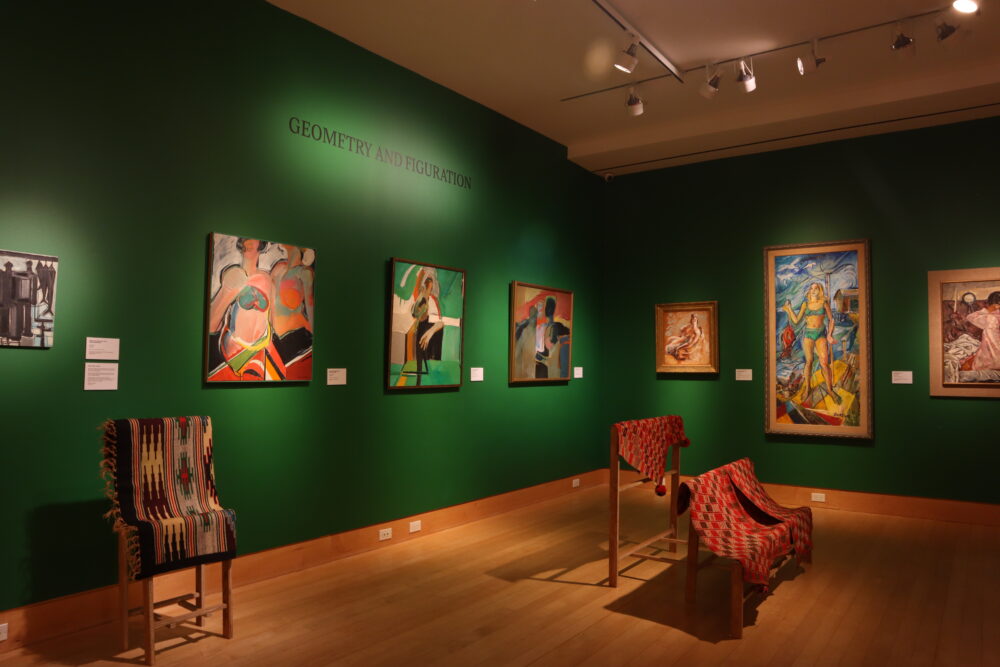
In marking its 50th anniversary, The Ukrainian Museum presents selections from its permanent collection in a novel framework: not chronological but through the formal threads — Color, Form, Geometry, Figuration, Texture, Line, Black & White, and Ornamentation — that run through fine art and folk art alike, binding them into a single, continuous visual culture. Paintings, sculpture, kilims, rushnyky (embroidered ritual cloths), traditional costume, and folk objects are placed in conversation through the aesthetic affinities that have always connected them rather than period or provenance.
This organization reflects something essential about Ukrainian art: that the boundary between the artist’s studio and the village workshop was never as rigid here as European academic tradition insisted. The woven kilim and the painted canvas share a formal intelligence. The embroidered rushnyky and the modernist composition speak the same visual language. A Living Canvas makes those connections visible. Read more about the exhibition, here, A Living Canvas: The Ukrainian Museum At 50.
The Museum designed the exhibition in partnership with Cooper Union. The Museum is currently developing a formal long-term relationship with the School of Art and the School of Architecture, wherein faculty and students will engage directly with the Museum’s exhibition design work — contributing models, drawings, and fabricated elements to gallery installations, and working on real curatorial and community-centered design challenges within a living institution. This collaboration speaks directly to shared interests in social practice and the expanded public role of art institutions.
“The 50th milestone presents a unique opportunity to honor our history while reimagining our role as a vital cultural resource for the Ukrainian diaspora globally, recent arrivals displaced by war, and the broader New York community — Ukrainians and non-Ukrainians alike.”
“The Museum’s location in the East Village is central to its mission. For over a century, this neighborhood has been the hub of Ukrainian cultural life in the city while also playing a pivotal role in New York’s artistic and intellectual history. The Museum sees itself as a bridge between these histories — rooted in a diasporic community yet deeply embedded in the broader civic and cultural fabric. A key institutional priority is strengthening ties with local organizations, universities, and neighbors to ensure that small museums and community-based cultural institutions continue to shape the identity of the East Village as it evolves.”
— Elena Siyanko, Executive Director, The Ukrainian Museum
The Museum’s full slate of anniversary events, exhibitions, and institutional investment initiatives will be announced this summer.
ABOUT THE UKRAINIAN MUSEUM
Since 1976, The Ukrainian Museum has been a vital part of New York’s cultural landscape — a showcase for Ukraine’s rich artistic heritage and complex history, dedicated to preserving its folk-art traditions while celebrating its unique contributions to 20th-century and contemporary art.
Founded by the Ukrainian National Women’s League of America, the genesis of the Museum’s collections dates to 1933, when the UNWLA purchased 600 folk art items for the Ukrainian pavilion at the Chicago World’s Fair — items that would form the nucleus of the collection decades later. Ukraine was then under Soviet and Polish rule; the pavilion was the only one at the Fair not backed by an independent national government. It was endowed entirely by the Ukrainian community in the United States. Two million people visited.
After World War II, when all of Ukraine fell under Soviet rule, the UNWLA resolved to establish a museum to house, preserve, and exhibit the folk art collection it had acquired. A nationwide fundraising campaign followed, and on October 3, 1976, the Museum opened in Manhattan’s East Village — the neighborhood where generations of Ukrainian immigrants had settled. Today, the collection encompasses more than 8,000 folk art objects, 3,000 fine art works, and 30,000 archival items — one of the largest collections of Ukrainian cultural heritage outside Ukraine.
When Crossroads: Modernism in Ukraine opened in 2006, The New York Times noted that artists long attributed to Russian culture were, in fact, Ukrainian — a recognition that speaks to the Museum’s longstanding commitment to restoring accurate cultural context to Ukrainian art and heritage.
Since Russia’s full-scale invasion in 2022, the museum’s mission has become more urgent than ever. In 2022, with support from Bloomberg Philanthropies and Booth Ferris Foundation, the Museum launched SAFE, its global initiative supporting museums and cultural workers in Ukraine, and was recently recognized with a grant from the Leon Levy Foundation.
Under new leadership and through programming and exhibitions like the current A Living Canvas and the upcoming The Ground Shift Beneath Our Feet, the Museum is deepening its outreach and community partnerships, welcoming the thousands of Ukrainians displaced since 2022, and reimagining its physical space as an open, welcoming threshold — for immigrants, for neighbors, for anyone seeking connection to Ukrainian culture and to each other. It does so not only in a spirit of celebration, but also with reckoning and resolve, as a statement of resistance to any force seeking to erase Ukrainian identity and the Ukrainian people’s will to exist as a free nation.
