Gift of Ilarion and Svitlana Cholhan
A LIVING CANVAS:
THE UKRAINIAN MUSEUM AT 50
17 May 2026
A century ago, fine art and folk art were considered separate entities. Rigid academic conventions designated their practitioners as, on the one hand, “artists” and, on the other, “applied artists” or artisans or craftspeople. The unique character of Ukrainian modern art lies precisely in the fact that these two worlds were always closely allied in the nation’s cultural consciousness. Despite the hierarchies imposed by European academics, most Ukrainians recognized no real division between these two powerful forms of human expression. The exhibition A Living Canvas: The Ukrainian Museum at 50 traces the continuities inherent in a native Ukrainian aesthetic. It focuses on formal elements that illustrate the deep affinities between the fine and folk art creations of Ukrainian masters — works that, collectively, express a worldview of hope and expectation, an ever-present quality of the Ukrainian sensibility.
A Living Canvas also pays tribute to the curatorial team that shaped it and to the institutional memory its members embody: Dr. Myroslava M. Mudrak, Professor Emerita of Art History at The Ohio State University, who has defined the critical frameworks through which Ukrainian modernism is understood; Lubow Wolynetz, the Museum’s Folk Art Curator, whose deep knowledge of the collection’s textile and decorative holdings is unparalleled; founding Director Maria Shust, under whose leadership the Museum’s foundational identity was formed; Dr. Olha Yarema-Wynar, Textile Conservator at the Metropolitan Museum of Art for over 20 years; and Dr. Maria Rewakowicz, current Head of Collections, whose stewardship has continued the Museum’s mission to preserve and expand the permanent collection. These five are not only the architects of the exhibition; they are part of the story it brings to life.
Gift of Ilarion and Svitlana Cholhan
The exhibition presents The Ukrainian Museum’s collection as it has never been experienced before. In lieu of a conventional thematic or chronological account of Ukraine’s cultural heritage, A Living Canvas is organized around the formal threads that weave the fine arts with the decorative art of textiles, costume, and folk art across centuries and geographies. This organization reflects something essential about Ukrainian art: that the boundary between the village workshop and the artist’s studio was always fluid and mutually beneficial. The connections between the woven kilim and the painted canvas, the embroidered rushnyk (ritual cloth) and the modernist composition are materially tangible by sharing the same visual language. A Living Canvas makes visible their common qualities.
— Elena Siyanko,
Executive Director, The Ukrainian Museum

Zenon and Olena Feszczak Collection
Black And White
Although a range of compelling contrasts in visual representation can be achieved through texture, volume, form, and materiality, the juxtaposition of black and white offers a good starting point for discovering the affinities between the folk and fine arts.
Be it the single threads of black embroidery that come together as a line in movement across the surface to render a symbolic motif that, once multiplied on a cloth, becomes the basis of ceremonial wear, or the striking void created by Alexander Archipenko’s black sculpture, which frames an empty space for reflection, the Ukrainian spirit has always tended to the existential and the spiritual in artmaking. The interplay of positive and negative space, familiar from the woodblock print, finds an equally refined expression in black-threaded embroidery on white homespun cloth or in openwork netting and white-on-white embroidery as was typical of the Poltava region. Embroidered vintage ritual cloths (rushnyky) and women’s shirts from the Borshchiv region set alongside Archipenko’s lithographs demonstrate how black-and-white contrasts become not merely a design principle but a mode of visual thought.
Geometry And Figuration
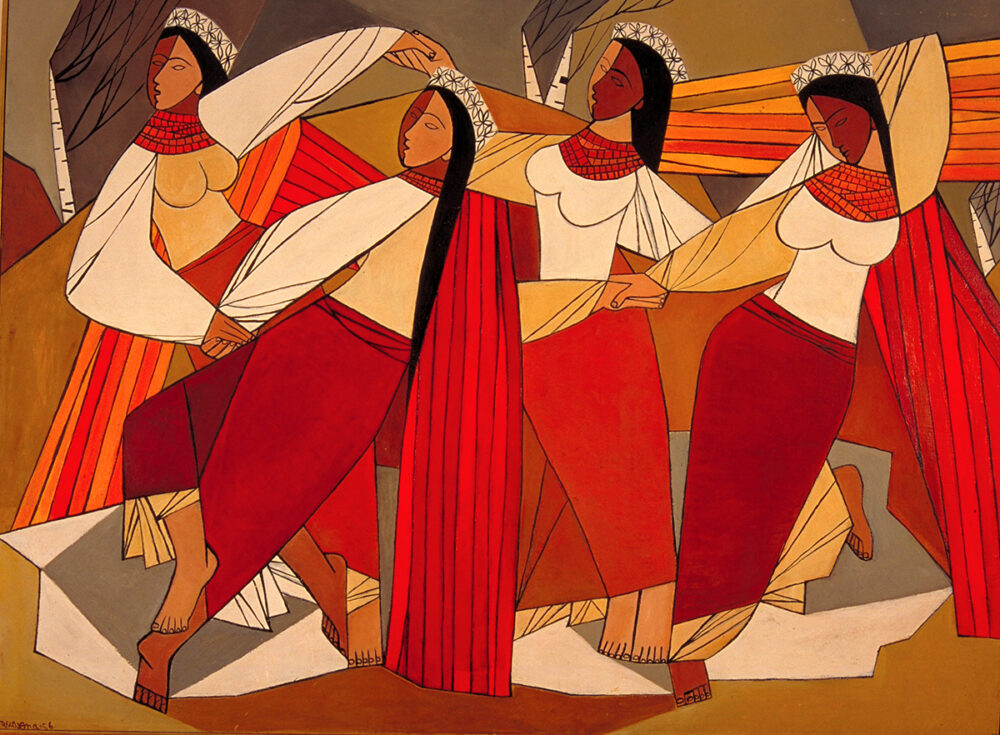
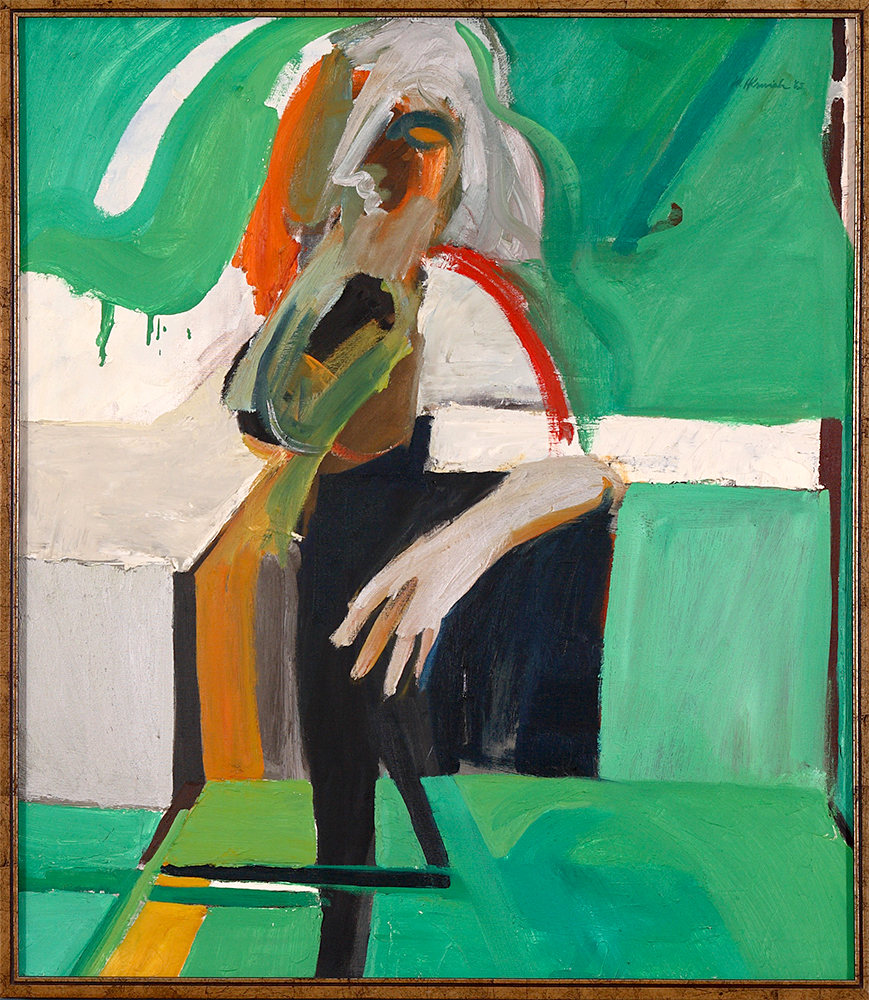
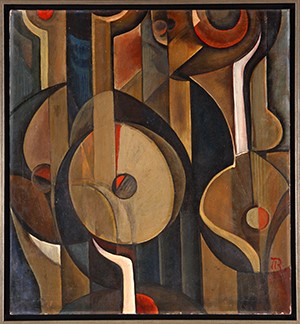
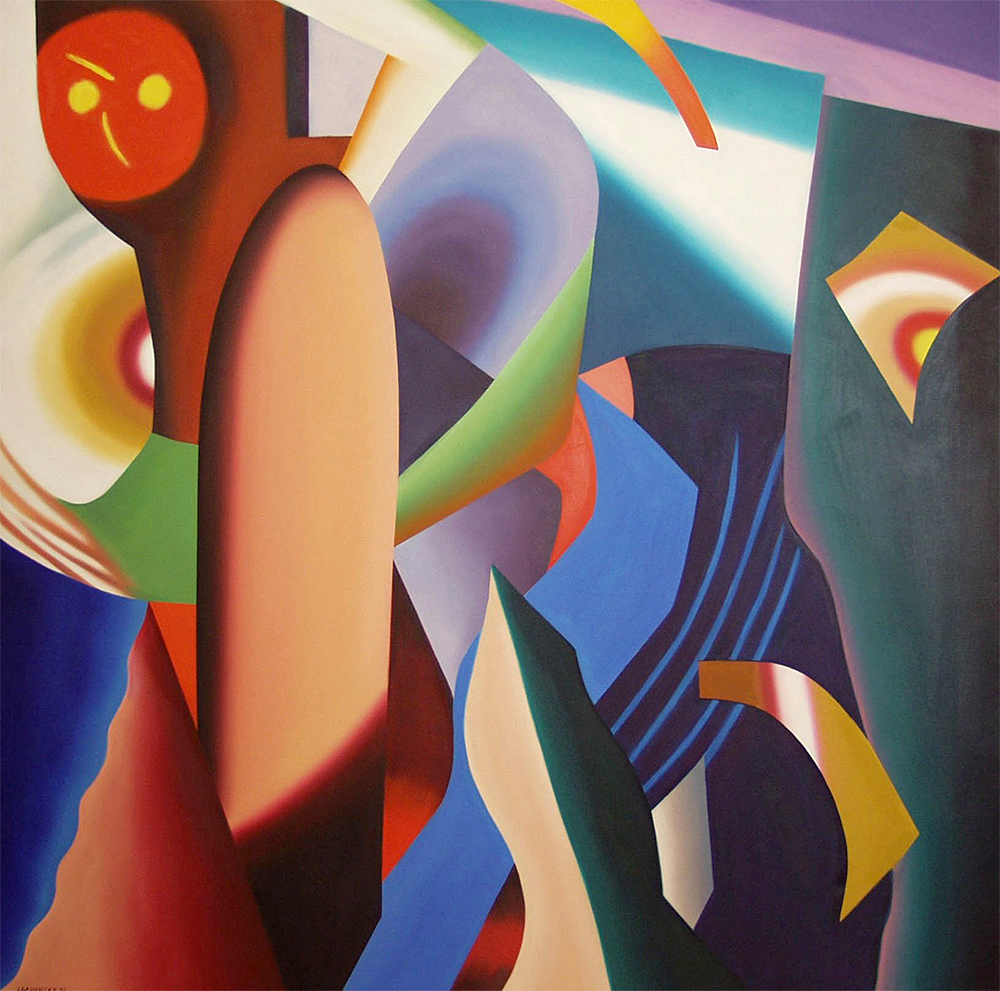
Spanning the naturalistic to the abstract, the energy of Oleg Sohanievich’s bold geometric shapes accented by daring exchanges of color and structure serves as a countervalent to the descriptive overtones in Mykhailo Chereshnovsky’s sculptured Madonna, Archipenko’s sultry reclining nude, David Burliuk’s impastoed surfaces, and Alexis Gritchenko’s poetic lyricism. As each of the artists acknowledge the academic female model as their starting point, they render her presence through a subtle manipulation of recognizable forms and nuanced references to the complexity of her inner being. Turning the female form into a symbolic cipher of grace, beauty, and fecundity, Volodymyr Makarenko adds to her power by recalling the striking visual force of the traditional female skirt, the checkered plakhta, as if to suggest her primordial origins in Ukrainian traditions. Makarenko’s eternal feminine animates the structural logic of the plakhta with strong horizontal and soaring vertical lines. Elsewhere, the force of reductive geometry blends clarity and utility in design while providing an escape — outside your apartment window, as it were — into transcultural, cosmic, and astral worlds as suggested by Marta Hirniak Voyevidka’s three paintings.
Gift of the artist
Gift of the artist
THE TREE OF LIFE
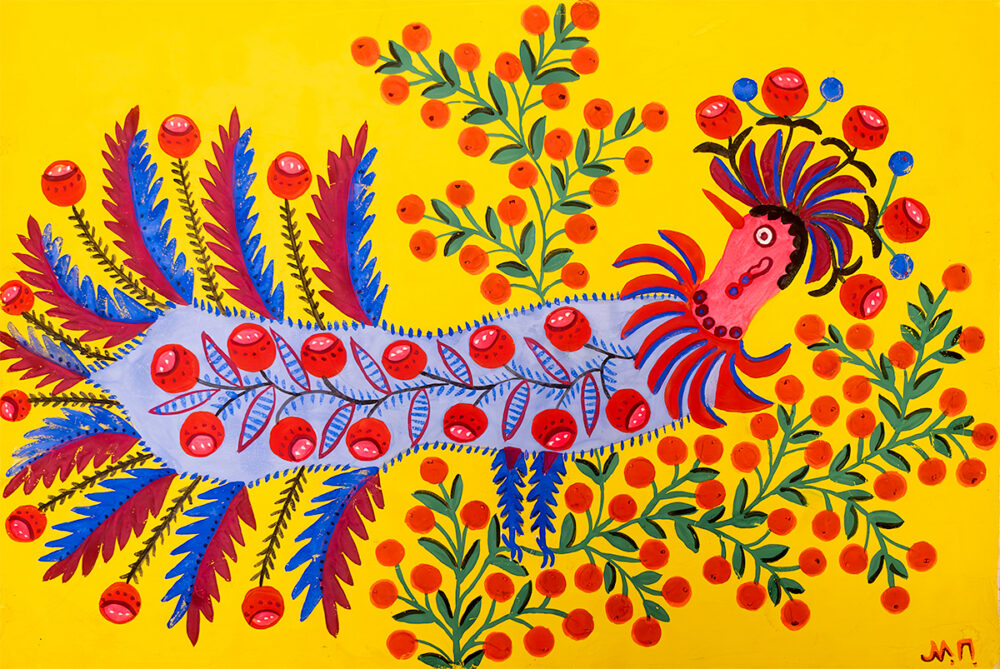
As with many ancient cultures, one of the most ubiquitous symbols in Ukrainian folk art is the depiction of the Tree of Life. Its simple form, in whatever iteration, carries profound, cosmogonic meaning, simultaneously questioning and asserting one’s place in the universe. Traversing ages and linking generations, the roots of the Tree of Life penetrate deeper than the earth’s core; above ground, their flowering in different stages of bloom and unfolding of buds yet to open reach farther than the firmament above. The powerful image, rendered vibrantly by Irma Osadsa in a contemporary reading, is a metaphor for enduring existence — a belief that undergirds the Ukrainian spirit and is unleashed in pictorial form as an affirmation of the universe.
That coding is incorporated into simple, natural materials: ceramic vessels, woolen weavings, homespun ritual cloths, and the basic egg, known as the pysanka — a symbol of rebirth integrated with the message of the Resurrection at Easter. The egg loses all its fragility once encoded with this symbolic message. Egg-laying birds, who give genesis to life, are seen as the protectors of a world in all its natural beauty and harmony — the very message embodied in the naïve paintings of Maria Prymachenko.
ICONOGRAPHIC TRADITIONS
Originating from the Greek, the term “iconography” refers to the Biblical Word presented as a visual image, or icon. The concept of “writing an image” comprises an important aspect of Ukrainian Christian culture. With its Byzantine origins, the faith of Ukrainian Christians celebrates the Eastern traditions for which the image is not so much a representation as an article of faith. The style of this imagery maintains the principles of flat two-dimensionality to reflect the sacred world inhabited by saintly figures. It is at odds with the illusionistic descriptive world of the Renaissance that would have us think we are seeing an image as if outside our window. Thus, Sviatoslav Hordynsky’s Garden of Eden — a Genesis story well known to all but treated in the Byzantine manner — goes well beyond its literalness. Icons maintain distance from the descriptive, realistic world as we know it and are meant to transition the beholder into the realm of spirit and belief.
Central to that tradition is the image of the Mother of God (Theotokos), whose symmetrical, gravity-defying body makes clear that she, once human, now deity, is between worlds mediating for us earthlings. (Orans refers to praying.) Her ovoid face and almond eyes and her elongated stature are standard Byzantine code for a prayerful state that transcends this world. Traditionally rendered in a linear rather than a painterly way, these stylistic devices, which also include curved, rhythmic contours and transparent, earthen tones, are reiterated in secular paintings with equally symbolic value for Ukrainians. The bandura — the national instrument of Ukraine — functions in much the same way as a religious icon. Commonly depicted in Ukrainian pictorial arts, it represents the “soul” of the Ukrainian nation. When played, the meditative vibrations of the stringed instrument resonate with melancholy and pensiveness, and with a lyricism that carries one back into the mighty age of Cossack bards and their epic songs.

Ivan Bernatsky Collection
TEXTURE AND MATERIALITY
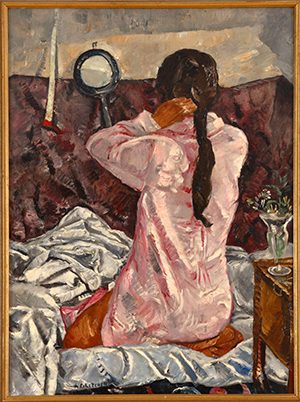
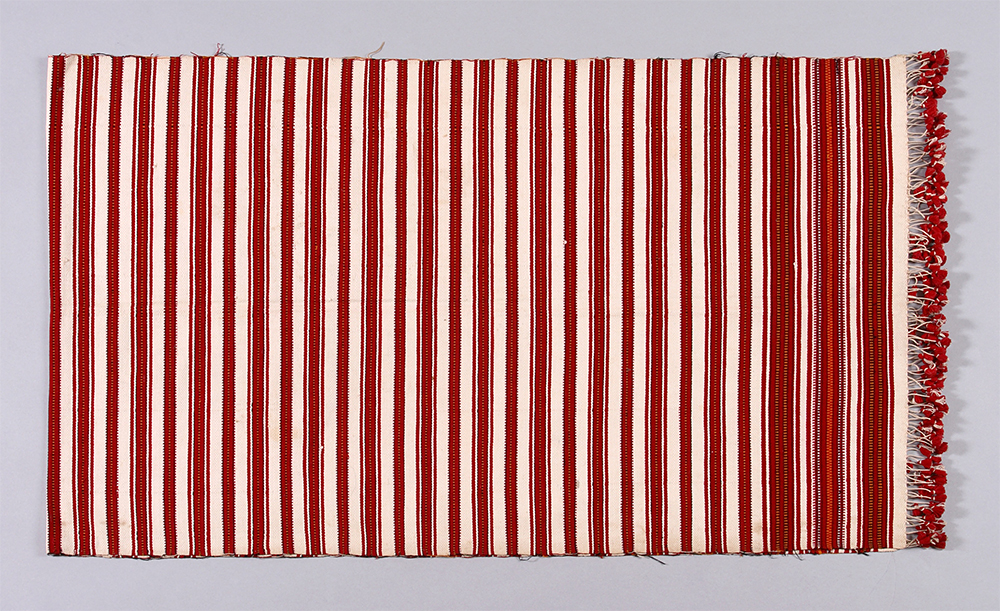
While attuned to their native traditions, Ukrainian fine artists have always remained in step with contemporary developments in the art world. The paintings of Mychajlo Moroz are most certainly inspired by the European post-impressionists. Be it the thick layering of paint in the manner of Van Gogh or the flattened valleys of southern France depicted by Cézanne in a faceted, planar manner, they also share in the tactual quality of Hutsul wool coverlets with their characteristic zigzag designs. The thickness and weightiness of the lizhnyk (as it’s called in Ukrainian) celebrate the generations- old sheepherding traditions of the Carpathian mountain region of western Ukraine. (See the shepherd’s cloak, called a hunia.) The colorful bedspread not only engenders the preciousness of the material used but honors the very process of making it. Thus, like the thick strands of dried paint on Moroz’s canvases that trace the painter’s every gesture, we find ourselves thinking about man’s labor in shearing sheep and cleaning fleece, of carding clods of wool and spinning raw animal fiber into workable threads, and the actual process of weaving on a loom to make a functional object so beautiful, and yet so simple.
The Ukrainian avant-garde painter and Futurist poet David Burliuk co-opted the French word “facture” to emphasize both texture and process in making an authentic work of art in a modernist vein. By introducing the concept of “faktura” in 1912, Burliuk insisted on exposing the explicitness of an artist’s paint strokes as if touching the “coat of some fabulous wild beast.” We find that quality in Petro Lebedynets’s abstract painting, the ragged sculpture of Petro Kapschutschenko, and the poppies of Luboslav Hutsaliuk. The multi-stranded abstraction of Arcadia Olenska-Petryshyn achieves the same aim without building up the painting surface.
LINE AND SPACE
As the fundamental element of pictorial art that orients our vision, line structures a composition, shapes forms, and is constantly engaging with space as it encloses or cuts through it. Natalia Pohrebinska’s majestic landscape gives evidence of this process in a monumental way. By introducing pockets of color created by lines in motion across the canvas and opening up a spatial vista that seems to explode with energy, the abstract work serves as a counterpoint to the more conventional open-air landscapes of Gritchenko and Vasyl H. Krychevsky, where sea and land join to create pronounced linear edges in the composition. The illusion of a deep space is challenged by Archipenko’s relief, whose physicality and three- dimensionality are effected by a layering of objects projecting off the surface. Rectilinear edges allow us to recognize the table on which the objects in this still life rest.
No more literal and tactile is line than in the sculpture of Konstantin Milonadis, whose interplay of voids created by curved wire bespeaks of excited motility in contrast to the web-like architectonics of Jacques Hnizdovsky’s composition. Unlike the animated telephone poles of Olenska-Petryshyn’s painting, Hnizdovsky seeks to contain the webbed energy of cropped trees along the lines of an oblique linear perspective.
Line is the element that organizes rhythms and patterning as in Hutsul wooden caskets and plates, as well as domestic textiles. On a sartorial level, it offers the effect of lengthened body architecture in worn garments.

A CELEBRATION OF COLOR
Ukraine’s fertile agricultural lands provide a bounty of natural beauty. Set against an expansive azure sky, the vegetation creates a kaleidoscope of vibrant colors and bursts of energy that invigorate the spirit. From simple village gardens filled with spiraling hollyhocks to fields of wildflowers amidst sentinel-like sunflowers that touch the horizon, color abounds in the everyday life of Ukrainians and is celebrated through the eye of the artist and in ritual dress. From brassy steppe grasses weaving through the landscape reminiscent of Jaroslava Lialia Kuchma’s textiles to expansive skies billowing into cosmic realms caught by Ilona Sochynsky’s spatial abstractions, color represents a liberating element in the Ukrainian mindset yet is always connected to nature.

Ivan Bernatsky Collection
STORYTELLING
Ukrainian traditions, regional customs, and rituals, along with local legends and folklore, provide a rich legacy for storytelling. Using the conventions of traditional iconography (linearity, rhythmic contours, flattened space) and naïve folk art, the illustrative style of these artists has served to popularize Ukrainian culture across national borders. The reductivism of their imagery and detailed decorative elements resonate with the innocence of childhood. Their art speaks of simple joys and fanciful escapes into storybook settings that not only relay a Ukrainian worldview but capture its existential moments. Having studied, worked, and established themselves professionally in countries distant from their homeland — from Venezuela, Czechoslovakia, and Germany to the United States — these artists, through their work, have helped to sustain diasporan life and identity in Ukrainian communities around the globe.
Gift of Peter Shyprykevych
A Living Canvas:
The Ukrainian Museum at 50
CURATORIAL TEAM
Dr. Myroslava M. Mudrak, Professor Emerita of Art History, Ohio State University
Lubow Wolynetz, Folk Art Curator, The Ukrainian Museum
Maria Shust, Founding Director, The Ukrainian Museum
Dr. Maria Rewakowicz, Head of Collections, The Ukrainian Museum
Dr. Olha Yarema-Wynar, Conservator, Department of Textile Conservation, The Metropolitan Museum of Art
Elena Siyanko, Exhibition Director and Executive Director, The Ukrainian Museum
Exhibition Designer: Sofia Gutman
Graphic Designer: Alexander Tochilovsky
Museum Preparators: Mykola Danyliuk, Petro Danyliuk, Yuri Tselenko
Lead underwriting generously provided by the Leshko family, in memory of Alexander Neprel.
