
Looking into Nuclear Pasts and Futures: The Kmytiv–Wismut Dialogue
Among the goals of the SAFE Grants Program is to support initiatives that reimagine museum collections, activate archives, and develop new models of audience participation. Contested Heritage: The Kmytiv Museum Digital Platform, proposed by curators Yevheniia Moliar and Jeannette Brabenetz, brings these approaches together through the collection of a small rural museum, opening new ways of thinking about contested heritage and its unexpected nuclear dimensions.
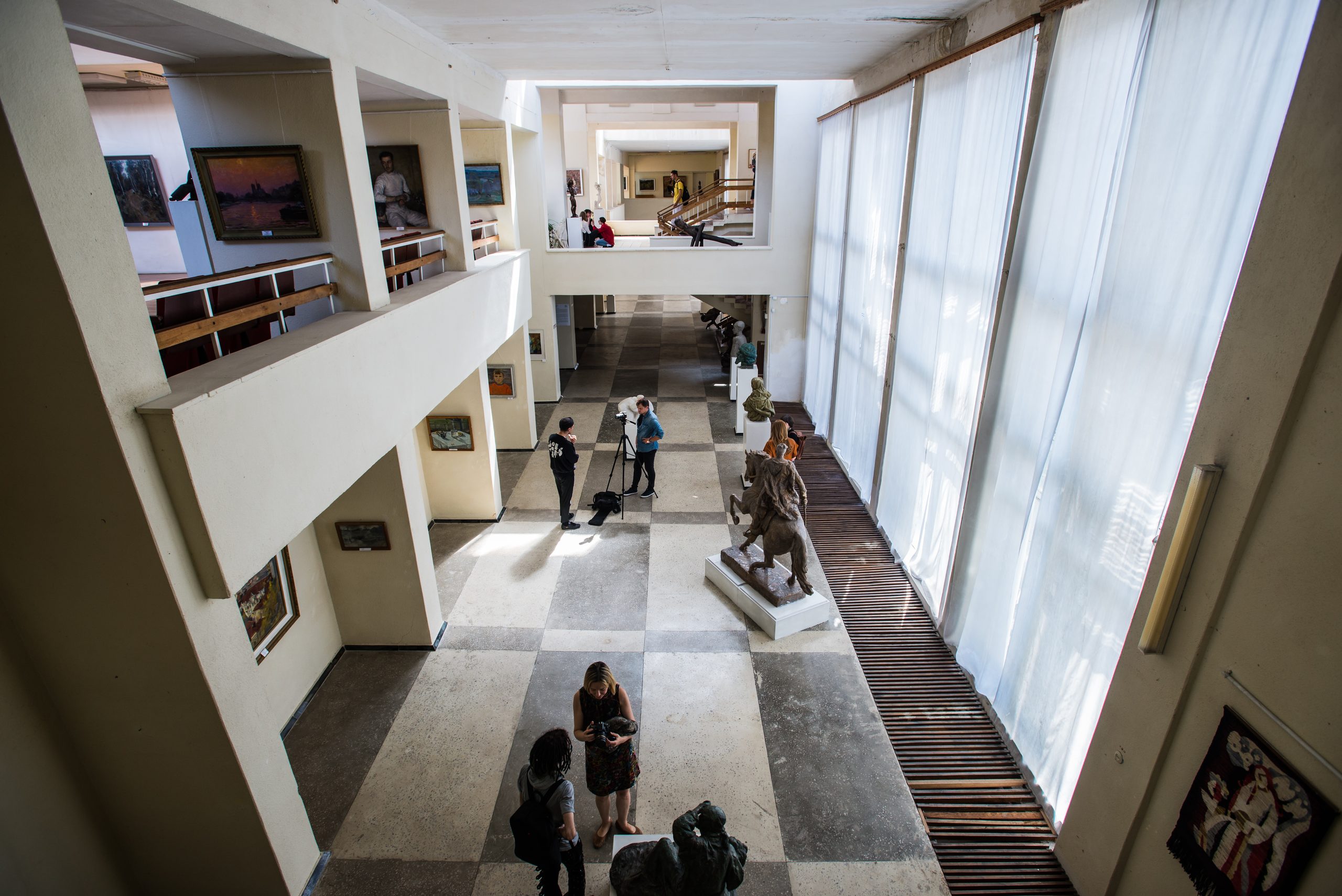
Interior of the Kmytiv Museum of Fine Arts. Photo: Natalka Diachenko, 2019
The project will create the first digital platform for the Kmytiv Museum of Fine Arts, expanding access to its collection and history at a time when physical access is limited. Following damage from a Russian attack in 2025, the museum building is undergoing repairs, while the war has significantly restricted access for international researchers. The platform will bring together digitized artworks, archival materials, building documentation, and curatorial texts by Moliar and Brabenetz.
Founded in 1974 through the initiative of artist, collector, and educator Yosyp Bukhanchuk, the museum grew from a gallery in a village school into a purpose-built institution that opened in 1985, with a collection drawn from state art funds and artists’ unions across the Soviet Union. It is a remarkable institution for a village of roughly 500 residents, located about 120 kilometers from Kyiv along the Kyiv–Chop highway.
For Yevheniia Moliar, an art historian and curator specializing in Soviet-era visual culture, Kmytiv offers a unique site for rethinking this history. Together with Jeannette Brabenetz, a German curator working with Kulturstiftung Haus Europa, they are developing the Ukrainian-German Contested Socialist Heritage project, which examines how socialist art, institutions, and memory are understood in the contemporary context of both countries.
Their work brings Kmytiv into dialogue with the Wismut mining company collection, which includes more than 4,300 works assembled by the state-run Soviet-German uranium-mining enterprise between 1946 and 1990. Placed alongside Kmytiv’s images of agricultural labor and collective-farm life, the Wismut collection offers another perspective on Soviet production and invites us to consider a question that has taken on new urgency today: How does Russia’s nuclear threat against Ukraine reshape our understanding of nuclear history?


Lilia Kudelia speaks with Yevheniia Moliar and Jeannette Brabenetz about Kmytiv’s contested cultural legacy and how curators can activate museum collections to surface contemporary concerns.
Yevheniia, you helped bring Kmytiv from a relatively overlooked post-soviet institution into the center of contemporary cultural conversations in Ukraine. What was it about the museum (its collection, staff members, immediate community, or dedicated audience) that you recognized as having this potential? Q1. Since the full-scale invasion, your team, led by historian Leonid Marushchak, has saved hundreds of thousands of museum artifacts and works of art. Salvaging cultural objects in frontline territories often means working under extreme pressure and danger. Have you been able to adjust these operations in recent years compared to the early stages of the invasion?
YM: For me, Kmytiv is a truly unique phenomenon because it makes all the complexities and contradictions of heritage very visible. On one hand, the museum can be understood as a propagandistic, showcase project within the Soviet system of art production: a large purpose-built art museum in a small Ukrainian village, meant to demonstrate the supposedly high level of culture Soviet society had achieved. On the other hand, it genuinely became an important cultural centre for the village — and these two things exist side by side without resolving into one another.
That same tension sits behind a question Jeannette and I, together with two art historians, Constanze Fritzsch and Katharina Neuburger, keep returning to in our Contested Socialist Heritage project: how do we define a work of art versus a historical document? Kmytiv makes this especially concrete. A respected Ukrainian art historian once described the collection as the “leftovers of the art funds” — it was never assembled according to what we’d now call a canon of masterpieces, but simply reflects how Soviet art was actually produced, selected, and distributed. To me, that doesn’t diminish its value at all; if anything, it’s exactly what makes it worth studying, both as art and as historical evidence.
This is exactly why I think Kmytiv has such potential today. It shows that difficult heritage can’t be reduced to a simple choice between preserving and destroying. The task isn’t to smooth out its contradictions, but to make them visible, explain where they come from, and create space to think about them.
Kmytiv Museum has a recent history of bringing contemporary artists into dialogue with its collection. How do you see this approach evolving, and what new conversations or perspectives do you hope these encounters can create for the community?
YM: Gestures of Attitude, a project curated by Nikita Kadan in 2019-2020, was an experiment — a kind of catalyst that helped awaken this museum, bringing its collection into dialogue with contemporary art for the first time. Since then, this practice has continued to evolve, with several independent art projects taking place at Kmytiv, including the current exhibition Lines of Time.
I think this is a generative way of working with the collection, but it also raises an important question: does contemporary art function as a kind of permission for socialist art to be shown today, legitimizing its presence in the museum — as though it needs a critical frame placed beside it before it can be considered safe to display?
Our current project, Contested Socialist Heritage, also engages with this question. As an international Ukrainian-German project, it brings Kmytiv into dialogue with the Wismut art collection, allowing us to look at socialist heritage from two different national perspectives—and to ask how similar histories can become visible, uncomfortable, contested, or silenced.
For Kmytiv, there is also an important human dimension. The museum is not only a contested collection; it is part of the personal and family history of the village. Many residents are connected to it directly — some through relatives who worked on building it, others through family members who once worked at the museum itself or simply grew up visiting it as children. In the museum’s archive, we found photographs of local residents working on the construction of the building itself. This kind of “people’s construction” was, in many ways, a classic Soviet propaganda, method — but in the memory of those who took part, it remains simply their own. If we label the museum itself as propaganda, do we also have the right to label these personal stories the same way?
Jeannette, what becomes visible when you place the Kmytiv and Wismut collections in dialogue? What does this comparison tell us about the different ways socialist heritage is remembered and contested in Ukraine and Germany?
JB: The way in which the socialist legacy is dealt with varies – naturally also against the broader backdrop of current events in Ukraine and Russia’s war of aggression since 2014. In Germany, too, there is not just ONE discourse; however, the history of German reunification has given rise to very specific processes of negotiation regarding the degree of artistic freedom or ideological preconditions in both German states – whether the subject was Socialist Realism or Abstract Art – which continue to this day.
Unlike in Ukraine, there is still no museum in Germany – or, to be precise, in East Germany, which was under Soviet occupation until 1989 – that is dedicated exclusively to this cultural and artistic heritage. In the Bid Book for Chemnitz as European Capital of Culture 2025, the idea of a centre for socialist modernism – in the present day – was indeed raised in theory, but no one has dared to take up this idea, let alone speak openly about it.
In this respect, the Kmytiv example is exceptionally noteworthy, because here – apart from works by East German artists – works from all the Soviet republics were collected and exhibited. Furthermore, it strikes me as extraordinarily daring, and perhaps almost at odds with the art forms on display there from today’s perspective, that such a progressive, avant-garde building was chosen for the presentation of these works.
The legacy of Wismut, a company that was involved in the dangerous mining of uranium, has no such fixed location where these meaningful discussions and negotiation processes – as Zhenia has just mentioned – could take place. In our resulting publication, questions about the collection were also raised from a Ukrainian perspective for the first time in the history of the art collection – namely regarding the threat of a nuclear strike, for which the (including physical) proximity to one’s own collection apparently seems too close.
In this respect, I believe that the international context of the Contested Socialist Heritage project has opened up new horizons – including regarding the possibilities and understanding of contemporary art – and has enabled engagement with the collections in a way that has not existed before. Although individual access to the art collection has been granted in the past, to my knowledge there has not yet been any exhibition that critically examines Socialist Realism in the way that Gestures of Attitude has done with regard to the socialist legacy. We can therefore learn a great deal from the Ukrainian example and from the institutional openness towards such curatorial experiments.